


Since 2007, Move LA has helped shape some of the region’s most ambitious infrastructure and policy solutions—bringing together civic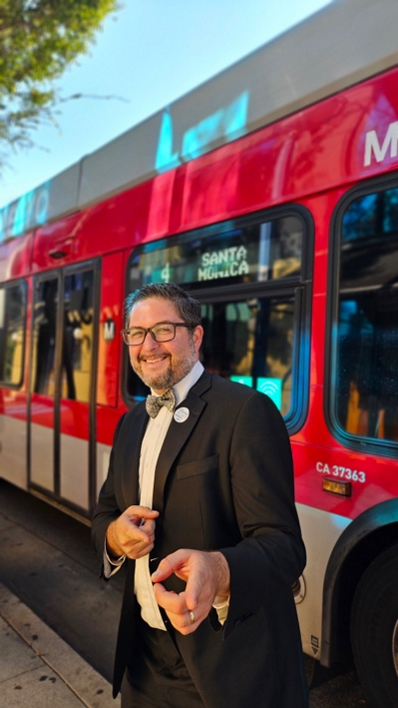 leaders, advocates, and communities to advance meaningful change across Los Angeles County. Currently at the helm is Executive Director Eli Lipmen, a longtime leader in civic engagement and coalition-building. Below is a conversation with Eli about his path to this work, Move LA’s approach to driving impact, and what lies ahead.
- You’ve been a leading voice in civic engagement and transportation advocacy in Los Angeles for many years. What drew you to this work, and what inspired you to lead Move LA?
I was drawn to this work because of the belief that public policy works best when it’s shaped by the people it’s meant to serve. Early in my career, I saw how decisions on public investment were too often made in silos—without sufficient community input, and without fully accounting for equity, access, or long‑term impact. At the same time, I saw the immense power of bringing diverse stakeholders together around a shared vision for a better region. My mentor, Marlene Grossman, thought that my vision and experience would be a good fit for Move LA, and she invited me to join the board in 2010.
Move LA stood out to me because it operates at that intersection—connecting advocacy, policy, and coalition‑building to turn bold ideas into real outcomes. Since its founding, Move LA has played a quiet but critical role in shaping some of Los Angeles County’s most transformative investments, leading with collaboration rather than ideology.
I was inspired to lead Move LA because of its commitment to building broad, durable coalitions that span sectors, geographies, and lived experiences. The organization understands that lasting change doesn’t happen overnight—and it doesn’t happen alone. It happens when we align community voices, civic leadership, and political will around solutions that move people, strengthen neighborhoods, and create opportunity for generations to come.
- Move LA has played a key role in shaping major infrastructure and policy efforts across Los Angeles. How would you describe the organization’s approach to turning big ideas into actionable solutions?
Denny Zane brought an entirely new approach to the space when he invited 35 leaders from the business, labor, and environmental communities to discuss our infrastructure needs in 2008. Many had never spoken, visited each other’s offices (imagine labor leaders visiting the granite-lined headquarters of the Greater LA Chamber!), or even sat on the same stage together!
Move LA’s unique innovation was to engage these leaders in a “blue sky” conversation where we thought big about transformative policies to achieve victories on some of the most important issues we grapple with today—affordable housing, homelessness, economic opportunities, racial and social equity, clean air, clean power, and clean transportation.
- Collaboration is central to Move LA’s work. What does it take to build and sustain the kind of coalitions needed to move complex initiatives forward in a region as diverse as LA County?
Our coalition now brings together labor unions, environmental, equity, social justice, business, faith, seniors, people with disabilities, and many more advocacy organizations and organizers representing the diversity of Southern California. By engaging with these leaders and their organizations, we build cross-sector coalitions to secure buy-in from key constituencies and identify potential roadblocks, enabling us to enable transformative change, not just incremental policies.
Move LA’s work is effective because we focus on measurable improvements in the quality of life for the people we serve by addressing their “kitchen table” challenges: transportation and housing costs, commute times, air quality, and access to good-paying jobs. This is the basis for every measure we have initiated, convened, and sponsored since 2008, which generates nearly $4 billion per year in public funding to serve mostly extremely low- and very-low-income residents.
However, we are uniquely effective because we don’t just win an initiative and then walk away; we dig deep and ensure implementation is equitable and in the public’s best interest. This is the reason the Irvine Foundation should award Move LA its 2026 Leadership Award–it is the implementation work that is hard, decades-long work that has not received the same levels of support from funders, but requires the most dedication and attention.
- Since 2007, Move LA has helped advance transformative investments in transportation and beyond. What impact are you most proud of—and what has it meant for communities across the region?
We have achieved a tipping point in LA County thanks to funding from Measure R and M. Metro opened a brand-new LAX Transit Center that connects two rail lines, the LAX People Mover, a dozen bus lines, and a world-class bicycle hub. Metro will open a subway to Beverly Hills on May 8—a long-awaited dream for many of our board members that has been nearly 40 years in the making. And Metro boasts the world’s longest light-rail line (the A Line)—recently extended to Pomona–and the second-highest daily ridership in the country.
Our system will only improve from here because of the ongoing investment of sales tax revenue in capital projects like the extension of the D Line to Westwood, the Sepulveda Transit Corridor, and the extension of the K Line to create a one-seat, one-hour ride from LAX to the Hollywood Bowl that connects four rail lines. On top of that, we are seeing the construction of bike paths and a bike-share program for shorter trips, as well as improvements in safety, cleaning, and service on buses and rail. Metro is expanding the popular Transit Ambassador Program, which improves the customer experience and bus speed and reliability by expanding bus-only lanes and an enforcement program to keep them clear for buses.
- Looking ahead, what opportunities or priorities are top of mind for Move LA, and how can partners and the broader community engage in advancing this work?
Californians are struggling right now as gas prices have increased dramatically due to unrest in the Middle East. Public transportation is an affordable and readily available alternative. However, for many, transit does not run frequently or reliably enough to ditch their cars. Our priority is securing funding to expand transportation services and make them more reliable so that your bus and train arrive on time, every time. We are also working to change the culture around transportation to reflect today’s realities. People want a diversity of options to travel–they want to use their car when it is necessary, but many see bicycling, walking, and taking public transit as a better option than sitting in traffic, paying a high price for parking, and polluting the environment.
One way we change culture is by building a community around transportation. Move LA is hosting SoCal Transit Month to deepen support for transit across Southern California among transit advocates, community groups, transit agencies, businesses, and other stakeholders. SoCal Transit Month features a wide range of pro-transit events across the region designed to expand engagement with potential allies, get more people to ride transit, generate favorable press, and help elected officials understand the importance of supporting and expanding transit. Our goal is to share the joy of riding public transit and build stronger relationships between transit agencies and transit riders/advocates.
Next Post
Ballmer Group Food Access
February 26, 2026
Join our mailing list!
Keep up on the latest from Community Partners—our partnerships, learnings, grant opportunities, resources and more.